
Nine Patch Quilts for Every Style and Bed Size
Nine equal squares in three rows of three make one of the oldest and most adaptable blocks in patchwork, equally at home in a scrappy throw or a king-size bed quilt.
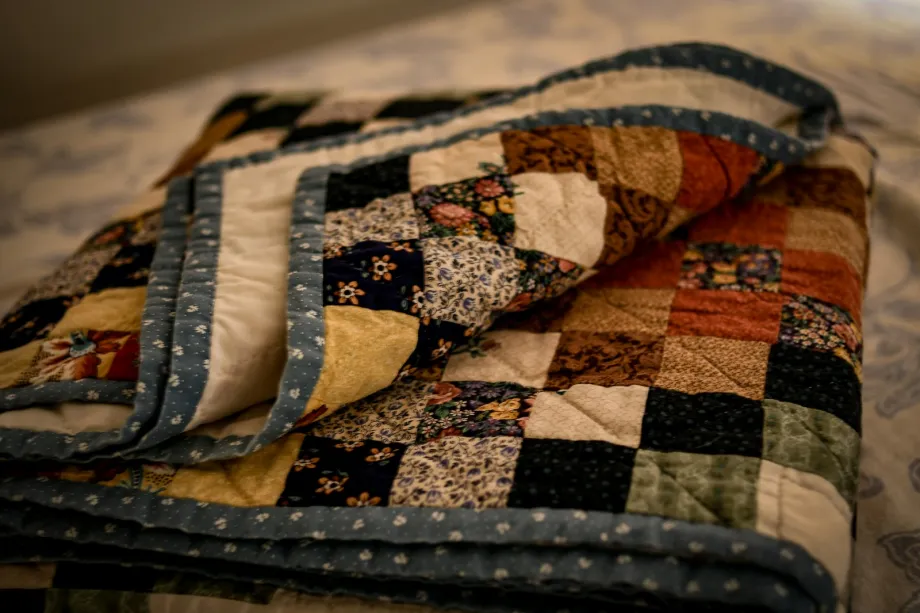
How a nine-patch is built
A nine-patch is a three by three grid of equal squares. It is among the oldest patchwork blocks and still one of the most useful. Beginners like it because the arithmetic is easy and every seam is straight. Experienced quilters keep returning to it because small changes in color placement give completely different quilts.
The sizing rule is simple. Each square is cut 1/2 inch larger than its finished size, which allows a 1/4-inch seam on every side. If you cut nine squares at 3 1/2 inches, the block measures 9 1/2 inches from raw edge to raw edge and finishes at 9 inches once it is sewn into the quilt.
You can sew blocks from individual squares, but strip piecing is much faster when the same two fabrics repeat:
- Cut strips 3 1/2 inches wide across the width of the fabric. Each block uses two dark-light-dark segments for every light-dark-light one, so plan on sewing twice as many of the first strip set.
- Sew a dark-light-dark strip set and press the seams toward the dark strips.
- Sew a light-dark-light strip set and press toward the dark center strip.
- Square up one end of each set and cross cut into segments 3 1/2 inches wide. Close the rotary cutter blade after every cut.
- Join two dark-light-dark segments with one light-dark-light segment between them.
Because both strip sets were pressed toward the dark fabric, the seams of neighboring segments lie in opposite directions and nest snugly. Pin at each intersection and the corners meet cleanly.
Planned or scrappy
Color choice changes the whole personality of a nine-patch quilt. A planned palette shows off the grid. Three shades of one color, say navy, steel blue and sky blue, give quiet depth, and a run of batiks or tonal prints can make each block look lit from one side.
A planned quilt needs only a few rules. Pick two clear value groups. Keep the contrast between the center and corner squares the same in every block. Use one background fabric throughout so the grid stays readable.
A scrappy quilt draws on your stash, and every square can be a different print. Scrappy nine-patches have an old-fashioned charm and use up leftovers well. To stop them looking chaotic, sort scraps into two piles, lights and darks, and stick to one placement: dark center and corners with light side squares, or the reverse. As long as that holds, the structure survives no matter how many prints you mix.
Alternate blocks and settings
Nine-patches sewn directly side by side make a busy, dense checkerboard. Alternating them with another block opens the quilt up and leaves space for quilting.
Plain squares
Swapping every other pieced block for a plain square halves the piecing. The plain blocks rest the eye and suit a large-scale print or a showy quilting motif.
On point
Turn the blocks 45 degrees and they sit on point, so the grid runs diagonally across the bed. You need setting triangles along the sides and corner triangles at the four corners to square off the edges before adding borders and binding.
Pieced alternates
Pairing nine-patches with a second pieced block creates secondary patterns. Next to hourglass blocks, star shapes start to appear where points meet. Snowball blocks, squares with their corners cut off by small triangles, give the quilt a softer, rounded rhythm.
The double nine-patch
A double nine-patch keeps the three by three grid but swaps some of the plain squares for miniature nine-patches. The usual arrangement puts small nine-patch units in the center and the four corners, with plain squares in the four side positions.
The numbers work like this. Cut the small squares at 1 1/2 inches, so each finishes at 1 inch and each small nine-patch finishes at 3 inches. Cut the four plain squares at 3 1/2 inches so they also finish at 3 inches. Five small units plus four plain squares make a block that finishes at 9 inches.
With five mini units in each block, accuracy matters. Test your seam allowance on scraps before you begin. Using a single background fabric for the plain squares lets the little nine-patches float clearly within the block.
Scaling up to a king-size quilt
A standard king mattress measures 76 by 80 inches, but mattress depth, pillow tuck and how far you want the quilt to hang all vary. The reliable method is to measure your own bed, decide on the drop, and then fit blocks, sashing and borders to that size.
One worked example: set 10-inch finished blocks nine across and nine down. Odd numbers in both directions mean the same block sits in all four corners, so alternate nine-patches with plain squares and you get 41 pieced blocks and 40 plain ones. The center measures 90 by 90 inches. A border that finishes at 5 inches on every side brings the top to 100 by 100 inches, which leaves 12 inches of overhang on each side of a 76-inch-wide mattress.
If you use 12-inch blocks instead, a seven by seven layout makes an 84-inch center (25 pieced and 24 plain blocks), and a wider border or sashing brings it up to size.
Sashing and borders
Sashing strips between blocks enlarge the quilt without adding more pieced blocks, and they keep bulky seams from crowding together. Remember to include their finished width in your sums. Borders frame the grid and protect the outer seams, and they are the easiest place to make small adjustments to the final size.
Frequently asked questions
What is the quickest way to piece nine-patch blocks?
Strip piecing. Sew two strip sets, one dark-light-dark and one light-dark-light, cut both into segments as wide as the original strips, then join three segments to form each block.
How many blocks do I need for a king-size quilt?
It depends on block size, sashing and borders. Measure the bed, add the drop you want, then divide by the finished block size. A nine by nine layout of 10-inch finished blocks, for example, makes a 90-inch center before borders.
What is the difference between a nine-patch and a double nine-patch?
A plain nine-patch uses nine single squares. A double nine-patch replaces five of them, the center and four corners, with small nine-patch units, keeping the same three by three grid.