
Understanding the Triple Irish Chain Quilt Layout
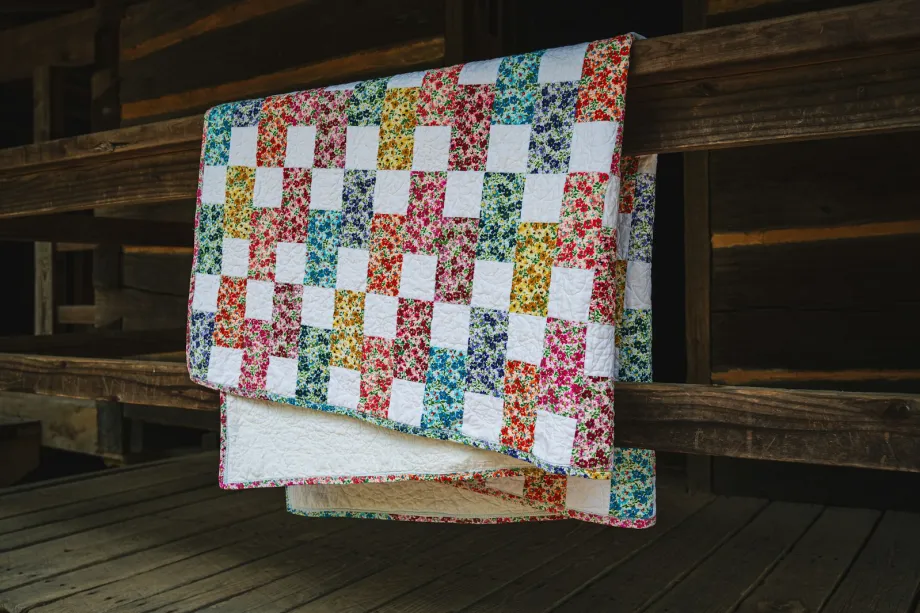
Three narrow diagonal chains crossing a pale background come from just two alternating blocks, one busy and one almost plain, set on a simple grid of small squares.
How the grid works
From across a room, a Triple Irish Chain looks like three thin ribbons woven diagonally over a pale field. Up close, the effect turns out to be simple. Two different blocks alternate in a checkerboard: Block A, packed with small colored squares, and Block B, which is mostly background.
Each block is drawn on a seven by seven grid of equal squares. In Block A the colored squares run corner to corner in bands, with a dark diagonal through the middle, medium squares on either side of it and light squares filling the gaps. Block B is a large plain background area with colored squares only at its edges or corners, depending on the version you follow. When the two blocks sit side by side, the colored squares on their edges meet, and the chains carry on across the plain blocks without a break.
Because both blocks share the same grid, every square in the quilt is the same size. That is what makes the pattern so well suited to strip piecing.
Picking fabric values
The pattern depends on value, meaning how light or dark a fabric reads, far more than on hue. You need three clear steps: a light background, a dark fabric for the center chain and medium fabrics for the two outer chains.
A plain white, cream or soft gray background gives the cleanest contrast. A quiet tonal print can work too, as long as its pattern does not fight with the small squares.
Use your darkest fabric for the center chain. Deep navy, forest green or charcoal all anchor the layout well. The outer chains need true mediums. If they are too pale they disappear into the background, and if they are too deep they merge with the center band, so three fine lines turn into one heavy stripe.
Before cutting anything, lay the fabrics side by side, photograph them and switch the picture to black and white. If you can still tell background, mediums and dark apart in gray, the chains will read clearly.
Planning a baby quilt
A baby quilt is a sensible first Triple Irish Chain. Fewer blocks keep the layout manageable while still giving plenty of practice with strip sets and pressing.
Here is the arithmetic for one workable size. Choose 1 1/2-inch finished squares, so each strip is cut at 2 inches to allow for a 1/4-inch seam on both long edges. Seven squares across give a block that finishes at 10 1/2 inches, or 11 inches unfinished.
Set the blocks three across and five down. With an odd number of blocks in both directions, all four corners of the quilt hold the same block, so the design looks balanced. Fifteen blocks means eight of Block A and seven of Block B. The center then measures 31 1/2 by 52 1/2 inches. A border that finishes at 3 1/2 inches on every side brings the top to 38 1/2 by 59 1/2 inches, a comfortable size for a crib or a play mat.
If you need a smaller quilt, a three by three layout (five A blocks, four B blocks) gives a 31 1/2-inch square center. Whatever size you choose, work out the numbers on paper before you buy fabric.
Strip piecing the blocks
Cutting hundreds of tiny squares one at a time is slow and invites errors. Strip piecing avoids most of that.
Cut 2-inch strips across the width of the fabric from the background, dark and medium fabrics. Block A is symmetrical, so row one matches row seven, row two matches row six and row three matches row five. That leaves four different rows. Sew a strip set for each row type, seven strips wide, following your block diagram for the color order.
Sew with an accurate 1/4-inch seam. Press each strip set before cutting, and press neighboring row types in opposite directions: row one toward the left, row two toward the right and so on. That way the seams nest when you join rows.
Square up one end of each strip set with your ruler lined up on a seam, trim off the uneven end, then cross cut into 2-inch segments. Each segment is one finished row of seven squares. Close the rotary cutter blade every time you put it down, even between two cuts.
Block B can be built the same way: short strip sets for the edges with a colored square at each end, and wide background pieces cut to size for the middle. Avoid stitch-and-flip corners here, because they produce triangles, not the square accents the chains need.
Assembling the top
Sort the segments by row type and build all the A blocks first, row by row, following your diagram. Because you pressed alternate rows in opposite directions, each seam meets a seam lying the other way. Butt them together and pin at the intersections; the squares will line up without fuss.
Lay out all the blocks on a floor or design wall, alternating A and B in a checkerboard with A blocks in the corners. Check that the chains run unbroken from block to block before you sew anything.
Join the blocks into rows. Press the seams of row one toward the right, row two toward the left, and keep alternating. Join the rows, pinning at each block seam, then add the border.
Quilting the open spaces
The plain blocks give the busy chains somewhere to rest, and they leave room for quilting texture.
Straight lines suit the pattern well. Diagonal lines running parallel to the chains across the whole quilt emphasize the direction of the piecing. Another option is to echo the chains with lines 1/4 inch inside the plain blocks, which frames the piecing and leaves the centers of the open areas puffier.
For a softer contrast, quilt a feather wreath, a loose floral loop or a stipple inside each plain block. Curves against a strict grid can be very pretty.
Thread color decides how much the quilting shows. Thread matched to the background keeps the texture quiet so the chains lead. A contrasting thread turns the plain blocks into a second focal point, which works best when the stitching is steady.
Frequently asked questions
How many fabrics do you need for a Triple Irish Chain quilt?
Plan on at least three clear values. A light background, a dark fabric for the center chain and one or two medium fabrics for the outer chains keep all three diagonal bands readable across the quilt top.
Can you make a Triple Irish Chain quilt from precut strips?
Yes. Precut strips that are 2 1/2 inches wide give 2-inch finished squares, so a seven-square block finishes at 14 inches. Sew them into strip sets and cross cut at 2 1/2 inches, exactly as you would with strips cut from yardage.
How should you quilt the plain background blocks?
Diagonal straight lines parallel to the chains emphasize the geometry, while a feather wreath or another free motion motif in each plain block softens it. Both work; the choice depends on whether you want the piecing or the quilting to lead.