
Free Charm Pack Quilt Patterns You Can Start Today
Charm packs give you a coordinated stack of 5-inch fabric squares without the cutting. This article collects free patterns that turn those precuts into finished quilts, from a simple patchwork grid to a disappearing nine-patch.
What is the easiest quilt to make with one charm pack?
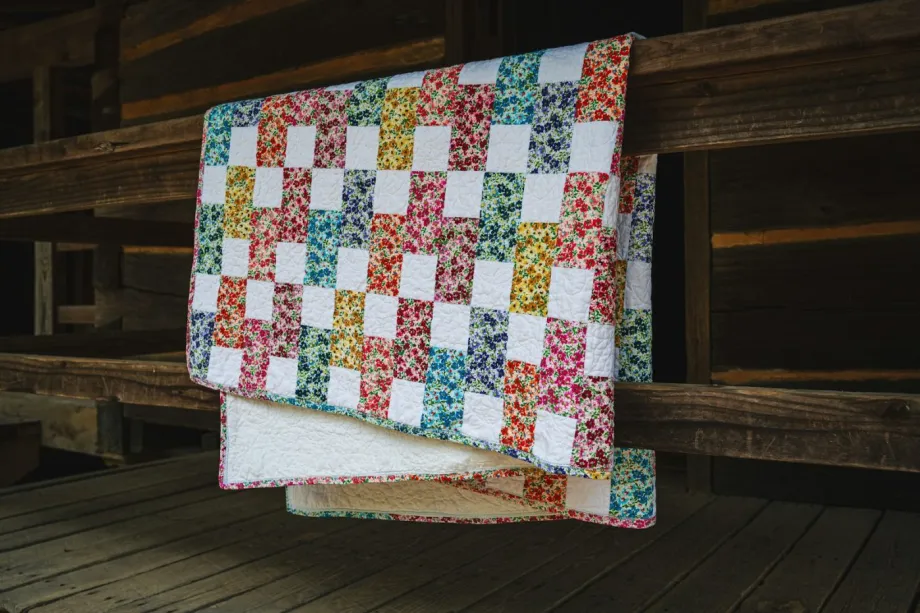
The fastest way to turn one charm pack into a finished top is a simple patchwork grid with sashing strips between the squares. You lay out the 42 precut 5-inch squares in a 6-by-7 grid, giving you a center of roughly 30 by 35 inches before you add anything else.
A single charm pack makes a piece too small for a lap quilt. Adding strips of solid fabric between the squares stretches it into a usable throw. Cut 2-inch-wide sashing strips from a neutral solid like white or cream and sew them between the squares and rows. The sashing adds about 10 inches to the width and 12 inches to the length, bringing the top close to 40 by 47 inches, a comfortable size for a child or a lap quilt.
You don't need to match points or cut triangles for this layout. The squares stay whole, and the straight seams line up naturally. Press each seam toward the sashing as you go. The whole top comes together in an afternoon.
How do you turn a charm pack into a disappearing nine-patch?
A disappearing nine-patch starts as a simple nine-patch block you cut apart and reassemble. A charm pack gives you exactly the right 5-inch squares for it. You sew nine squares into a 3-by-3 grid, then slice that block in half vertically and horizontally to create four new units. Rotate those units before sewing them back together, and the original layout scrambles into a design that looks far more complex than the work you actually did.
The charm pack's mix of prints does the work here. Cutting across seams and rearranging pieces makes the finished block read as a scrappy, multi-fabric pattern. You never piece a single triangle or odd-shaped unit. Beginners often pick this as their second project right after a plain patchwork quilt.
Steps for one block:
- Pick nine charm squares and arrange them in three rows of three on your design wall or table.
- Sew the squares into rows with a quarter-inch seam, then join the rows to form a standard nine-patch block.
- Press the block flat and measure the midpoint in both directions. Cut straight through the center vertically and horizontally, giving you four equal quarters.
- Rotate the top-left and bottom-right quarters 180 degrees while leaving the other two as they are.
- Sew the four quarters back together into one block, matching the seams as you go.
- Make as many blocks as your layout requires and join them with sashing or side by side for a busier look.
A single 42-square charm pack yields four finished blocks with six squares left over. Mix in solid squares from your stash to stretch the count, or make a smaller project like a table runner.
Can you make a quilt with just half-square triangles from a charm pack?
Half-square triangles (HSTs) turn a single charm pack into a quilt top with strong diagonal movement. Each pair of 5-inch squares gives you two HSTs, doubling the number of units you started with.
Place two charm squares right sides together. Draw a diagonal line from one corner to the opposite corner on the lighter fabric. Sew a scant quarter-inch seam on both sides of the drawn line, then cut along the line itself. Press each unit open toward the darker fabric and trim to 4½ inches square.
Arrange the finished HSTs in rows to create a chevron pattern by pointing all seams in the same direction across each row. For a diamond layout, rotate every other HST so the diagonal seams form a zigzag that runs both horizontally and vertically. A single 42-square charm pack yields 84 HSTs, enough for a small throw about 36 by 42 inches finished.
What free patterns work when you have two charm packs?
Two charm packs open up layouts where a solid background fabric frames each 5-inch print square. The alternating nine-patch and snowball block is a straightforward pattern that needs two charm packs and about a yard of a solid background fabric. You piece simple nine-patch blocks from the charm squares and pair them with snowball blocks that use background fabric for the corners.
A snowball block starts with a charm square and adds small background triangles at each corner. When you sew a diagonal seam across a 2.5-inch background square on each corner and trim the excess, the print square appears to float inside a soft frame. Alternating these framed prints with scrappy nine-patch blocks creates diagonal movement across the quilt top and nearly doubles the finished size compared to using charm squares alone.
For a balanced layout, arrange the blocks so no two identical prints sit next to each other. A design wall or a clean floor helps you step back and spot any fabric clusters before you sew the rows together. The contrast between the busy nine-patch blocks and the calmer snowball blocks gives the quilt rhythm without complicated cutting.
How do you finish a charm pack quilt without a border?
Finishing a charm pack quilt without a border keeps the project fast and uses every inch of your precut squares. You skip cutting and attaching border strips, so the quilt top goes from the design wall to the backing in less than an afternoon. The result is a clean, modern look that shows off the fabric prints right to the edge.
Square up the quilt top by trimming all four sides with a long ruler and a rotary cutter. Line up a horizontal seam with a grid line on your cutting mat, then trim away any uneven edges and stray threads. A squared top makes the binding lie flat and prevents wavy edges later.
Choose a thin binding cut at 2¼ inches to match the scale of 5-inch squares. Sew the binding to the front by machine, then press it away from the quilt before folding it to the back. Quilt in the ditch along the main seam lines, which secures the layers without adding a separate border design. The ditch quilting sinks into the seams and keeps the focus on the charm pack prints.
What is the best batting and backing for a lightweight charm quilt?
A charm pack quilt already has many seams, so a thinner batting helps it drape softly instead of feeling stiff. Cotton batting gives a flat, traditional look and breathes well, but the lightest option is a cotton-bamboo blend. Bamboo adds drape and a slight sheen without adding weight. Stay away from polyester batting if you want a true lightweight finish, because even low-loft polyester traps more heat.
For the backing, you have two practical paths. A single wide-back fabric in quilting cotton or cotton lawn saves time and avoids extra seams that add bulk. If you want to use every last piece of your charm pack, piece the leftover 5-inch squares into rows for a scrappy backing that coordinates with the front.
- Cotton-bamboo blend batting creates the softest drape for a charm quilt
- 100% cotton batting gives a flat, traditional look and breathes well in warm weather
- Wide-back quilting cotton eliminates piecing and keeps the back smooth
- Cotton lawn used as a backing adds a silky hand and reduces overall weight
- Leftover charm squares pieced into rows make a scrappy backing at no extra cost
- Avoid polyester batting, even low-loft versions, because it traps heat and adds stiffness
Frequently asked questions
Do I need to prewash charm squares before sewing?
Most quilters skip prewashing precuts because the small pieces can fray in the wash. If you plan to prewash, put the squares in a mesh bag and use a gentle cycle, then press them flat before cutting anything.
How many charm packs do I need for a throw quilt?
A standard throw around 50 by 60 inches typically uses two 42-square charm packs plus some yardage for sashing or borders. The exact number depends on your layout and whether you add solid blocks between the prints.
Can I mix different charm pack collections in one quilt?
Yes, mixing collections adds variety and a scrap-quilt feel. Stick to fabrics from the same designer or a shared color palette so the prints blend rather than clash.
What seam allowance should I use for charm pack patterns?
A scant quarter-inch seam is standard for quilting and works well with precut squares. Test your seam on two scrap squares first: sew, press, and measure. The joined pair should be exactly 9.5 inches wide before you start the main project.